Showing posts with label Alan Lantz. Show all posts

Wednesday, May 8, 2013

IMG_6599
The Lantz's home in Carroll Gardens
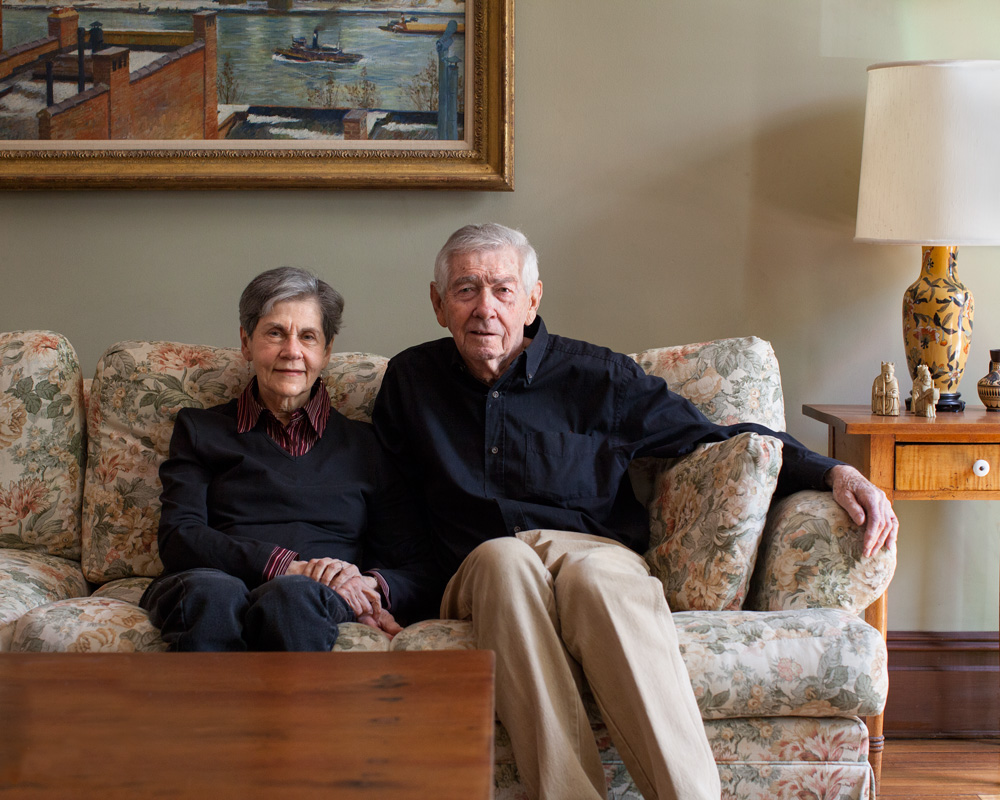
Cynthia and  Alan 
photo credit: Max Kelly
IMG_2675
Alan and Cynthia in 1987, after they moved into their home on Union Street
(family photo)
IMG_2681
IMG_6829
Almost 30 years after he wrote "Florida In Brooklyn", Alan Lantz's  humorous account of moving to the neighborhood to retire, which he followed up with "Twenty Years Later",  Alan comments on the recent changes to our community in an essay called "The Babyfication Of Carroll Gardens."

As promised, here now the last, but hopefully not the final installment of Alan Lantz's wonderfully written account of his years in Carroll Gardens.


The Carroll Gardens Chronicle
"THE BABYFICATION OF CARROLL GARDENS"
2013
By Alan Lantz

In two earlier essays, “Florida in Brooklyn” and “20 Years Later,” I attempted to trace the evolution of my adopted neighborhood, Carroll Gardens, Brooklyn, chronicling the changes that I observed from 1984 to 2004. I would have preferred to wait until 2024 which would have reflected forty years of transformation, but as I have aged, the observations of a previously grumpy young man have morphed into the dyspeptic reflections of a grumpy old man, so I am foreclosing upon my original intent.

First, in 1982, the year that we purchased our brownstone, today’s crop of young investment bankers would have been considered “ethnics.” Sipping a martini or swirling a glass of Chateau Petrus ‘59’ instead of imbibing wine made in the cellar would have been met with the observation, “There goes the neighborhood.” A note of confession: my wife and I retired to Carroll Gardens from Long Island as soon as our children left the nest. We had hoped to live in Greenwich Village but were unable to come up with the necessary bucks. We are, therefore, that most despised category of inhabitant – gentrificationists –albeit early ones. In our defense, my wife was born in Brooklyn and spent her youth living on Columbia St. in a neighborhood then known as Red Hook/South Brooklyn. (It is simply untrue that young women from this neighborhood were known as Red Hookers, meaning Marxist prostitutes.) She graduated from PS142 on Henry St. and her library was a half block from where we now live. And, we have a wine cellar, but it is stocked with Chateau Brooklyn Brewery.

Today’s Carroll Gardens has passed from the stage of gentrification to the stage of babyfication. When we arrived we rarely ever saw a pregnant woman. The sight of a stork flapping through the neighborhood would have evoked exclamations of disbelief from the stoop-sitting residents. Today, the startling vision of a severely pregnant woman threading her way through a phalanx of strollers bearing tiny testaments to lust has become the trademark of the new Carroll Gardens. Indeed, perhaps Court St. should be renamed Courtship Street.

In addition to babies, the lanes are lined with bars, boutiques, burgers, banks, bike paths, and, boxes of discarded books (not too many bibles, though, and certainly no Gutenbergs). Among the extinct enterprises are the mom and pop shops which repaired shoes, produced home-made mozzarella, sausage, gelato, ravioli, and soups; Camereri’s Bakery where the movie Moonstruck was filmed; also Joe’s Coffee Shop where we hammered out the details of our house purchase and which served as a neighborhood clubhouse where one could sit all day nursing an espresso and complaining about changes in the neighborhood. Joe’s has been transformed into “16 Handles,”
a dispensary where yogurt can be created in 150 different combinations. When you finish your yogurt, you can follow it up with 150 positions of yoga, or, if you prefer, practice pilates. Real estate offices jostle each other, their windows ablaze with photos of studio apartments, a steal for twenty-eight hundred dollars a month, especially appealing to wealthy pygmies.

Another transformation of note is Carroll Park. We were thrilled when a playground with swings and a slide were introduced into the northwest corner of the park. My young grandchildren couldn’t wait to play in it when they visited us from the hinterlands. The only experience comparable for them was to ride the unusually decorated subways. Some called it graffiti in those days, but it was their introduction to “art.” And the elderly residents sunning themselves in the park spoke a foreign language, and thus provided the children with an experience akin to visiting southern Italy.

Two further rumors about the park are undoubtedly spurious: the first suggests that the boccie court is to be converted into a stroller racing track. The second is that all adults entering the park will be required to be accompanied by a child.

On a more serious note, recent developments which may sound ironic are true. First, the Eileen A. Duggan Senior Center at 380 Court St. which for 39 years provided seniors in Carroll Gardens with reduced-price hot lunches, classes in exercise and painting, guest speakers, health advice, companionship – in short, a place to make them feel welcome in a rapidly changing society. This past summer when we returned from vacation we found that the seniors had been evicted from the Center to be replaced by Kidville, a national chain which sells children’s clothing in addition to sponsoring theme parties for children.
A small sample of the parties includes Wiggle-Giggles for Ones, Little Explorers Safari Party (2 and up), Pretty in Pink Ballerina Party(3 and up), Super Heroes Birthday Bash (3 and up), Special Kosher, Dietary, and Allergy restrictive Parties, and 16 more types of toddler pleasing celebratory events. In addition, these fetes may be enhanced by professional photographers, magicians, videographers, tattoo artists, face painters, and numerous other specialists. You may be reassured by the knowledge that Ben Affleck and Jennifer Garner recently held a party for their 4 year old daughter Serafina at the Brentwood, LA. Kidville.

One-half block down on the other side of Court St. is a children’s establishment called “If I Were a Toy” which features toys, games, art and music classes, balloons, an Italian playgroup, and haircuts. If it’s your child’s first haircut, he or she will receive a “First Haircut Certificate” and a lock of hair as a keepsake. The adjoining courtyard features about a dozen children’s rides for about fifty cents a pop.

Also lining Court and Smith Streets are newly established tutoring services which will help launch your child’s entry into the kind of competitive preschool, kindergarten, elementary school, middle school, high school, college, graduate school, and career that will enable him or her to secure a job which will, in turn, enable the earning of a salary and life style which will make it possible to live in Carroll Gardens. Rumor has it that the College Board Corporation is in talks with Stanley Kaplan to develop a prenatal tutoring program.

The demographic of development is another rapidly changing element which makes every buildable square foot of ground an enticement to the developer. Indeed, in a preceding article which I wrote in 2004, I observed, that when the former longshoremen’s clinic was purchased by Long Island College Hospital, and then languished, that “the smart money on the street thinks it will be sold to developers whose vision and cash will spin the straw of former examination rooms into the gold of condos.” The property on which the building was located, along with the adjoining parking lot, was sold in 2007 for a reported 23.5 million dollars. The classic, grey marble building, erected in 1957 after a previous developer demolished a half block of 19th century brownstones - was itself torn down by a developer with plans to erect a seven story black behemoth of a building, with ten adjoining townhouses. 32 condominiums were projected along with a block of storefronts on Court St. Perhaps some desperately needed banks or real estate offices? Despite an outcry from the local occupants that the building was totally out of keeping with the 19th Century character of the neighborhood, the developer, the Clarett Corporation, rode roughshod over complaints of residents – which subsequently led to the zoning board’s passage of a requirement limiting the height of future buildings. Construction resulted in disruption of a formerly peaceful neighborhood, causing serious damage to an adjoining 1840 building. The developer denied any responsibility, costing the building’s owner a large sum of money to replace the large cornice. Subsequently, Clarett went bankrupt, convincing many in the neighborhood to believe in a Higher Authority. The current developer has been significantly more cooperative, changing the façade so that the building will be less intrusive. Both New York Magazine and the New York Times have published articles referring to the project, the magazine’s story illustrating the middle-size condominium that will be available for $1.85 million dollars. Better sign up immediately for your child’s tutoring sessions.

A final buttress to my thesis: On May, 3 1982 my wife and I were in the law office of Francis A. Scotto, Counselor at Law, 300 Court St. in Brooklyn for the closing on our house in Carroll Gardens. Mr. Scotto is long gone from the premises, but the Spa which replaced him left this past year, and about six months ago a Pediatrician’s office and clinic opened. Sic Semper Babiensis. Stay tuned for the next transformation.

POSTCRIPT

I wrote this article in January, 2013. On Friday, February 15, 2013,The New York Times Arts Section reviewed an exhibit at the New Museum along with a picture of “Amazing Grace,” an installation of an assemblage of 300 discarded baby strollers collected by Nari Ward in 1993. (See photograph)

On February 18, 2013, The Times published a story entitled “Schools Struggle to Separate the Truly Gifted From the Merely Well-Prepared,” about how the NY City Department of Education was changing its admissions exam “to combat the influence of test preparation companies...especially for 4-year-olds…who are vying for increasingly precious seats in kindergarten gifted programs.”


Tuesday, May 7, 2013

_MG_2073web
Cynthia and Alan Lantz in their Carroll Gardens home
photo credit: Max Kelly
IMG_2687
Alan and Cynthia Lance in front of their beautiful Carroll Gardens Brownstone.
IMG_2681
IMG_2768 1
High School year book 1978
IMG_2767
Yes, that's me as a high school student, at the time I met Alan Lantz

In 1985, as a newlywed, I found my way to Carroll Gardens, settled and eventually bought and renovated a house and raised a family.  Little did I know that Alan Lantz, the librarian of my former high school on Long Island, had settled in the neighborhood to retire just a few years earlier. Our paths crossed a few times before I realized that the tall, soft-spoken gentleman who sometimes stood in line at the local bakery and produce store on Court Street was indeed the same kind librarian I had first met in 1975, the year I arrived in the United States and started tenth grade without speaking English at the local high school.
We have become good friends over the last few years as we lead our parallel Carroll Gardens lives.  
I have always enjoyed Alan's tale of how he and his wife chose to leave suburbia and move to Brooklyn to retire.  In 1984, he wrote a wonderful essay about their decision.  With his permission, I posted his "Florida in Brooklyn" on Pardon Me For Asking yesterday.
Today, I am pleased to share the second part of his Carroll Gardens Chronicle written in 2004, twenty years after he and his wife Cynthia moved to the neighborhood.
It is a real treat and every bit as enjoyable and humorous as the first part.
Stay tuned for Part Three, written in 2013, which I will post tomorrow. 

Here now is the second installment of the Carroll Gardens Chronicle.

The Carroll Gardens Chronicle
"TWENTY YEARS LATER"
2004
By Alan Lantz

Over twenty years ago my wife and I set sail from the bucolic hamlet of Northport, Long Island, in search of a new life on the Island of Manhattan. However, a ferocious storm in the form of Manhattan real estate prices drove us off course, and we landed instead on the rocky shores of Carroll Gardens in the Borough of Brooklyn. I described in my earlier essay “Florida in Brooklyn” how we originally looked on Brooklyn merely as a convenient conduit to Manhattan. Slowly, the rough charms of the Borough won us over, and we settled on Brooklyn as our final resting place (Union Street in Carroll Gardens, not Greenwood Cemetery). As we were drawn deeper into the rich, complex, urban stew that is Brooklyn, our earlier dreams of living in Manhattan evaporated like spit on a hot August pavement. Little did we realize then that we were part of a wave that would radically alter both the borough and the neighborhood. The engine of change was, for others, as for us, the cost of finding a place to lay one’s head at night
Only the super rich or the non-claustrophobic were entitled to inhabit Manhattan. All others who did not give up and head back to Des Moines or Sauk City had to evolve into a species known as “gentrifiers,” a term that evoked fear and contempt among the indigenous population, Over the bridge bearing the banner of gentrification trudged multitudes of young people, and the middle-aged like us in search of both shelter at a reasonable price and proximity to the neon charms of the City. Bohemians relocated from SoHo or the Village to Williamsburg or the then unnamed Dumbo. And, when daytrippers and baby strollers clogged those streets, the hip fled to Red Hook where even now they are under siege by Philistines and Progress. Young professionals who were shut out of the upper West Side poured into neighborhoods like Cobble Hill, Park Slope, Boerum Hill, or Carroll Gardens, bringing with them their tastes for radicchio and Chilean Sea Bass, and Ikea and Gap. Whereas for their parents the American Dream was home ownership, this new generation dreamed of finding a 700 square foot walk-up for under $2,000 a month.
Close-knit ethnic enclaves crumbled under the assault and retreated to Staten Island or New Jersey. Landlords urged on by realtors salivated and began a campaign to drive out long time occupants who paid lesser sums. Consequently, the former inhabitants of the brownstones in Carroll Gardens, usually multi-generational Italian families, were forced out or bought out on the cheap. The dumpster replaced the Brooklyn Bridge as the borough symbol, and the quintessential neighborhood sport of stoop-sitting came to be regarded with as much enthusiasm as Mad Cow Disease.
Gone now are the women who used to hang out of the window surveying the street scene and talking to the stoop-sitters below. Any woman who hung out of a window today would be the subject of a 911 call, suggesting an imminent suicide leap. Old Italian grandmothers in black have given way to hip young things in black with navel rings and tongue studs and cell-phones riveted to their ears.
A digression concerning black: When I once attended a performance at the New Wave Festival of The Brooklyn Academy of Music wearing a canary yellow sweater, the noir-clad minions of the avant garde shrank away from me as if I were Buffy the Vampire Slayer brandishing a large cross in their midst. Point taken. Now when I attend I dress in a sensible shade of charcoal.
There have been some positive changes. We remember when the New York area code, 212, became 718 for Brooklyn, a further stake in the Dodgerless heart of Brooklyn. Our friends on Long Island thought we had moved to Minneapolis. Now “718” is boldly emblazoned on designer T shirts hawked in trendy boutiques along Smith and Court Streets, and more than one tummy of a pregnant young thing is encased in a tight-fitting garment bearing the legend “Brooklyn Baby.”
Casualties of the transformation abound, however. Remnants of The International Longshoreman’s Union have been eradicated by the sale of their former union hall and its adjacent clinic. The marbled hall where hundreds of stevedores congregated to pick up their checks every two weeks has become ….a Mormon Temple. The clinic where longshoremen, their families, relations, and sometimes friends were treated gratis was sold to Long Island College Hospital where a skeleton staff does who knows what. The smart money on the street thinks it will be sold to developers whose vision and cash will spin the straw of former examination rooms into the gold of condos. The attached parking
lot has been privatized and the luxury cars now living there pay dearly to avoid the omnipresent traffic agents and their ticket pads.
Years ago a good friend of ours from Florence, Italy, stayed with us.When we walked him around the neighborhood showing him the bread bakeries, the pork store, the pasticcerias, the bocce court, the pasta and mozzarella makers, the coffee roasters, and a grocery store where a rudimentary Italian vocabulary was necessary to be served, we remarked that the neighborhood was like a small town in Italy. He snorted, “A small town in Southern Italy.” And, although no one now would mistake Carroll Gardens for Milan, still…..
Take Smith Street, for example. For years our favorite of the red-sauce Italian eateries held sway on Smith Street. Traditional. Papa in the kitchen, Mama behind the cash-register, the children behind the bar and waiting tables. A feast of veal parmgiana, broccoli raab, spaghetti, crusty bread, all washed down by a $10 bottle of wine, followed by inky expresso and biscotti. When we left, we glowed with contentment, our inheritance still intact. But a few years ago because of the explosion of upscale restaurants on Smith, Papa felt compelled to upgrade. An “authentic” chef was hired, and the menu began to sport such items as tuna tatare, crostini di buffalo, a rollatine of monkfish and skate, swathed in a reduction of goat cheese and chianti. We have never returned.
Chic Smith St. is one block away from our house. When we first saw it in 1978 we almost decided to stay in the suburbs. It was super-shabby, amply pot-holed, buildings sagging at angles that made the Pisa’s tower seem plumb-line vertical, and while not necessarily threatening, certainly not welcoming. Today the bodegas and ethnic social clubs have given way to such a number and variety of restaurants that rarely a week goes by without a new opening. There is an apocryphal story of a man who starved to death on Smith Street because when faced with choosing among the 300 eateries, he was paralyzed by indecisiveness and wasted away without ever crossing the threshold of one. Mom and Pop have been replaced by the concierge who tries to get reservations, the maitre d’ who welcomes you, and the ATM across the street where you excuse yourself to go after you see the menu prices. Just Kidding. There are still restaurants where great food can be had a prices well below those of Manhattan. Planted between the restaurants are clothing and craft emporiums, funky bars, antiques shops (since the customers are so young, what qualifies as an antique was created in the late 1970’s), an occasional realtor rooming with an “Abrogado,” and any other type of store-front enterprise that will be converted into a restaurant before the month is out.
Occasionally a double-decker red tour bus from Manhattan loses its way and the occupants stare down at the inhabitants of Carroll Gardens as if they were visiting a wildlife preserve. But the wilderness here is restricted to Carroll Park where pigeons, squirrels, and toddlers on swings play under the massive plane trees which surround a ball field, a bocce court, and a playground.
The Gowanus Canal, Carroll Gardens’ answer to the Grand Canal of Venice, is another institution which is being changed for the better. Ever since a highly successful cleaning program was undertaken , the once malodorous, highly toxic canal has become the site of
occasional boat tours. It is rumored that Brooklyn ladies dab water from the Gowanus on the back of their ears in the fashion of eau de cologne. A local beer garden styles itself
the Gowanus Yacht Club, and there is talk of a river walk with outdoor cafes and shops lining the once despised body of water. And, miraculously, crabs and fish have returned to the Canal. Gowanus seafood has not yet made it to the menus of Smith Street, but who knows? Can a Gowanus Regatta be far behind? Will cheering fans line the banks during the 2012 Olympics as world class swimmers thrash their way along the sparkling, crystalline waters?
Even now the dowdy precincts of Court Street are awash in spas, boutiques, yoga parlors, Starbucks, and artisanal bread bakers Admitting to the stigma of Brooklyn residence has been reduced to the extent that formerly when a friend of ours from Manhattan was introduced with us and was asked if he too came from Brooklyn,
he recoiled as if he had been struck with a lash. Recently we ran into him unexpectedly
dining in a Smith St. restaurant. We suspect that as soon as the rent on his Manhattan studio rises above $3,000, he may joint the ranks of those who throng the side walks in front of the myriad local real estate offices. And he may even become a fan of our soon-to-be named professional basketball team, the Brooklyn ________.
And finally, our choice of Brooklyn as a place of retirement is no longer considered by our former Long Island friends as a manifestation of insanity. Rather, they think of us as dimwits who somehow won the Megabucks lottery.


Please check back to read Part Three tomorrow.

You can find the first part Florida in Brooklyn here.